What is hypochlorous acid, how is it made and how does it differ from bleach? Hypochlorous acid guide →
HOCl is Nature's Perfect Germicidal ™
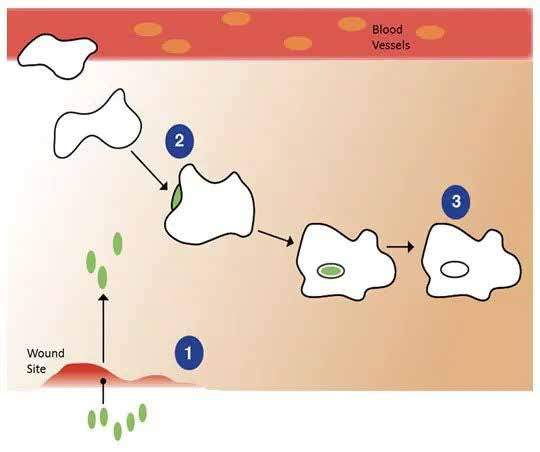
The diagram on the left shows how HOCl is produced in the human body and how it kills pathogens.
Pathogens enter the skin through a wound site and invade the body. Neutrophils (a type of white blood cell) come to the invaders and turn them. After surrounding, the neutrophil produces HOCl Acid to kill invading pathogens.
HOCl is produced in the white blood cells of all mammals. Since it is endogenous, it does not cause any damage, tissue damage or skin irritation.
HOCl chemistry is used in eye infections, premature babies and neo-natal hospital wards to kill germs, eczema, wounds, burns, diaper rash, foot fungus, acne, herpes and shingles, and IV. Stage is used to clean diabetic ulcer and kill bacteria in grocery stores.
HOCl has been used in the medical field for years and has a lot of research supporting positive results in numerous treatments and therapies.
HOCl chemistry is approved for use by both major regulatory bodies: EPA for surface disinfection and FDA for use on the skin.
HOCl is used to extend the life of fresh flowers, destroy germs in fresh eggs, and even help rice plants grow faster.
While HOCl has a unique weak odor that cannot be perceived by most users, very few people confuse the odor to a swimming pool and a small percentage of people confuse it with a mild bleach odor.
More Comparisons and Facts to Know:
Natural: "Bleach" (Sodium Hypochlorite) is a man-made chemical never found in nature; HOCl is naturally in the immune system of all mammals..
Safety: As a germicidal disinfectant, "Bleach" is legally obliged to have more than one warning and safety hazard precaution on its labels. HOCl germicidal disinfectants are free from warnings and first aid labels.
Gases: "Bleach" gases are dangerous and cause irritation and serious damage to respiratory systems and eyes. HOCl has zero hazard to respiratory systems or eyes.
The ingredients are water and a little salt, and then it goes through a special electrolysis (also called ionizer) process. How to make HOCl has been widely known for many years. However, it was not shelf stable. Our scientists worked for years to perfect the shelf stability so that it could stay in a bottle. HOCL is naturally unstable: it wants to "do its job" and then go back to salt water. After being used or dried, the HOCl returns to salt water without leaving any chemical residue.
Our product is pH neutral, another scientific feat of CleanSmart. CleanSmart's HOCl is the only antimicrobial that the same product is EPA-approved as a Hospital Grade Disinfectant and is also FDA-approved to treat wounds or burns. The same product does both! It is truly a smart science with extensive scientific, testing and editing work.